Biographical Details
Letter to Madge
This letter was written to Joseph’s sister Madge while he was at sea in Mid-April 1943, only a few weeks before his death:
Dear Madge
I was very glad to hear about you and Robert (their elder brother) meeting. I never thought it would be possible in wartime. You may be sure that if ever I reach Ceylon I’ll find your place and I’ll ring the bell and say in a broad Manchester accent “Is our Madge in!”. What would the Reverend Mother say!!
Seriously though, it would be a great privilege and I will never stop hoping it will take place.
I was very fortunate on one trip, I manage to visit Nazareth. It was a great spiritual experience to tread the same floor and to be within the same walls that the Holy Family once knew.
The stone table where St. Joseph worked is still there, though part of it has been taekn away to make room for the tomb of two Crusaders. the French nun who conducted us around told us they were brothers who came from England.
It was a hard tak to follow the nun who spoke in such queer English, I had to turn her word into very plain, practically pigeon-English for the benefit of a Negro soldier who in turn translated my words into his own language for the benefit of his two companions.
After we had visited the house we went to a rest room where the nun gave us some ice water as it was very hot, and there were also there an Arab couple who were having a wedding feast and they sent us over some sticky delicacies which I told the fellows they must eat because I imagined the Arabs would feel affronted if we didn’t.
Shortly after the nun led us into the church and we all tiptoed in and I genuflected and the others followed suit though they were non-Catholics and an aged French priest was waiting to commence benediction and besides us the congregation consisted of about 30 nuns. The service was nearly the same as ours and afterwards there was a kissing of a relic and it was a very stirring sight to see and hear the sweet voices of the nuns as they filed to the alter rails singing a hymn that seemed to end each verse with ‘Toujours’ repeated several times.
We all followed suit and after it was over and we went outside the nun gave me a flower off a bush that grew by the entrance to the Home of the Holy Family. I enclose it, hoping it will survive the journey.
I tried to capture a slight impression of my experience in some halting verse which I also enclose.
By now, I can appreciate how hot it can be in the tropics and how the sun can turn the ship into red hot steel. I always think of your convent in terms of cool tiled floors with breezes ciculating around. Remember Formby and Father Higham saying Mass of a morning in the Hall? That’s how I imagine it.
I went to an island on one trip and there was a French church there staffed by the Holy Ghost Fathers two of whom were English and they were very pleased to see me. One took me round a boy’s orphanage which he had founded and I saw them very busy at making furniture and their work was very good indeed. The church was very cool and clean and brightly coloured birds flashed in and out and their singing didn’t seem out of place in the least.
It makes me realise how truly Universal is the Church as I go to these different countries and walk around feeling strange, but the minute I enter a Catholic church I feel at home, just as though I’m in a church in a different part of my own town. It’s just the same save that the notices are in a different language.
I have not put my ships address on because it would take too long and it would probably get lost in transit if you wrote. Remember it’s got to go to London first and then has to wander round the world after me.
I hope your sense of humour is still strong because I heard a story that reminds me of a certain relation of ours. An Irishwoman was on about the Church of England pastor. He was High Church and the Irishwoman snorted “I don’t know why they’d call him ‘Father’, him that’s married and has children!” Can you guess who’d say that? The same relation that tried to eat the tomatoes that were painted on the plate!
You may be aware that ships were adopted by schools and we are adopted by a Welsh school to which the Captain sent some of my doggerel. The secretary of the British Ship Adoption Society to which it was first sent was interested and wrote me a flattering letter and said he was publishing a verse in the Societies Magazine. It will probably be the first and last time I’ve been in print! (you were wrong there Joe!).I’ll write it on the same sheet as the other rhyme. Well the temperature is past 100 degrees now and you know what it feels like to write in such an atmosphere so I will now end. I won’t ask you because I know you remember me in your prayers. So as I’ll soon be in my hammock, I’ll close with the words we used to trot upstairs with way back in the Robson Street days. Good Night and God Bless You.
Joseph
Joseph Cummings

This photograph was taken at Gee H. Rowland and Son, photographers, 29, King Street, Oldham. The Royal Artillery cap badge can be clearly seen. I am not sure why he went to Oldham for this when he lived in Withington, Manchester
Joseph Cummings – Grave in Syracuse
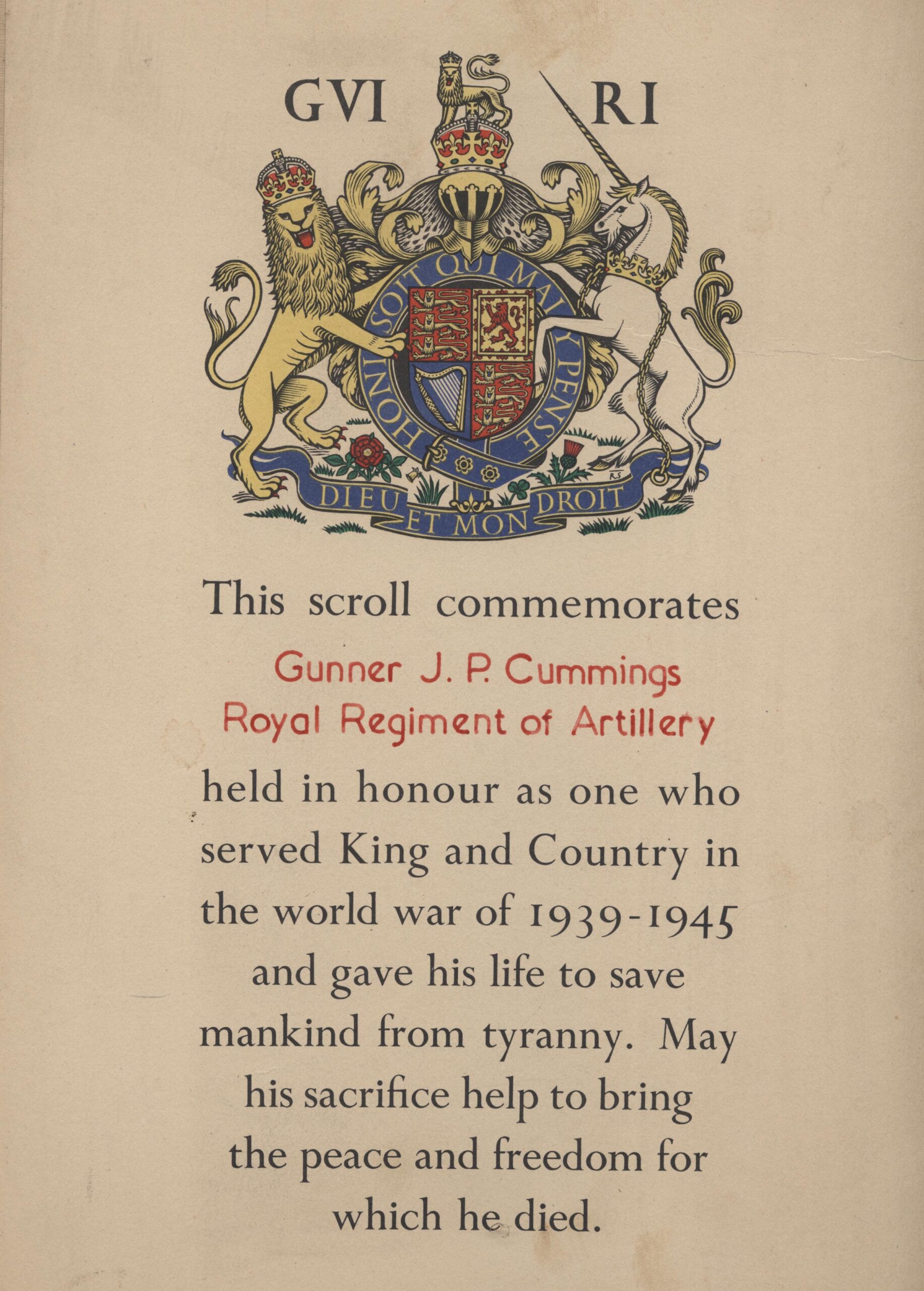
Here is the grave of Joseph Peter Cummings, Gunner, 1st Regiment, Royal Artillery Maritime:
Name: CUMMINGS, JOSEPH PETER
Rank: Gunner
Regiment/Service: Royal Artillery
Unit Text: 1 Maritime Regt.
Age: 32
Date of Death: 25/07/1943
Service No: 1809118
Additional information: Son of Robert and Margaret Cummings, of West Withington, Manchester.
Grave/Memorial Reference: III. D. 13.
Cemetery: SYRACUSE WAR CEMETERY, SICILY
Photo link to website of 1° Institute “ M. BARTOLO “, Pachino, (Sicily)

Regiment details
Extract from Lochwinnoch newspaper:
The Armistice Day Service this year will be the first not to be attended by a resident who served in the 1st Regiment Maritime Royal Artillery during the Second World War. This regiment had two batteries and the HQ of one was located here in Lochwinnoch from 1941-45. It was sited next to the Lochhead Furniture & Cabinet Work, affectionately and more frequently referred to as the Klondyke. The officer in charge was Colonel Dunkeld who reported directly to the man in overall command of the Maritime organisation, Major George Ewart whose office was in Cockspur Street in London.
Before the end of 1945 the barracks were closed. Captain Geoffrey Tharme R.A. was one of many serving members of the Regiment who married local lassies and stayed on in the village. Others who did so and made contributions in a variety of ways to post-war village life included Eugene Flanagan, Arthur Cusworth, George Jepson, Bobby Bryce, Bill Love, and John Scales. Sadly the last of these men died a few weeks after Armistice Day 2006. With his passing a page if not a chapter of local social history has been turned. Whoever is asked to lay the wreath on the memorial plaque to the regiment in the Parish Church this November will be doing so in a year when perhaps we should give an extra thought for the 1st Regiment Maritime Royal Artillery.
Newspaper Notices
I have found a newspaper notice concerning Joe’s death, probably from the Manchester Evening News:
CUMMINGS. _ Gunner J.P. Cummings (Maritime Regiment), posted as missing at sea July. the third and loved son of Mr and Mrs Robert Cummings, 81 Mauldeth Road West, Withington. Any information will be gratefully appreciated
Joseph Cummings – my uncle
This site is dedicated to the memory of my uncle, Joseph Peter Cummings from Manchester, England, who died in 1943 during the second world war while fighting for his country. He is buried in Syracuse Communal Cemetary, Plot 2, Row E, grave number 15. I will publish all the information I have about him, including a poem he wrote while visiting the Holy Land and letters he sent to his family

His unit was the Royal Artillery, his number was 1809118.
As far as I know, no member of our family has ever been to visit his grave.